AI agents push so much code, GitHub ran out of power for more servers.
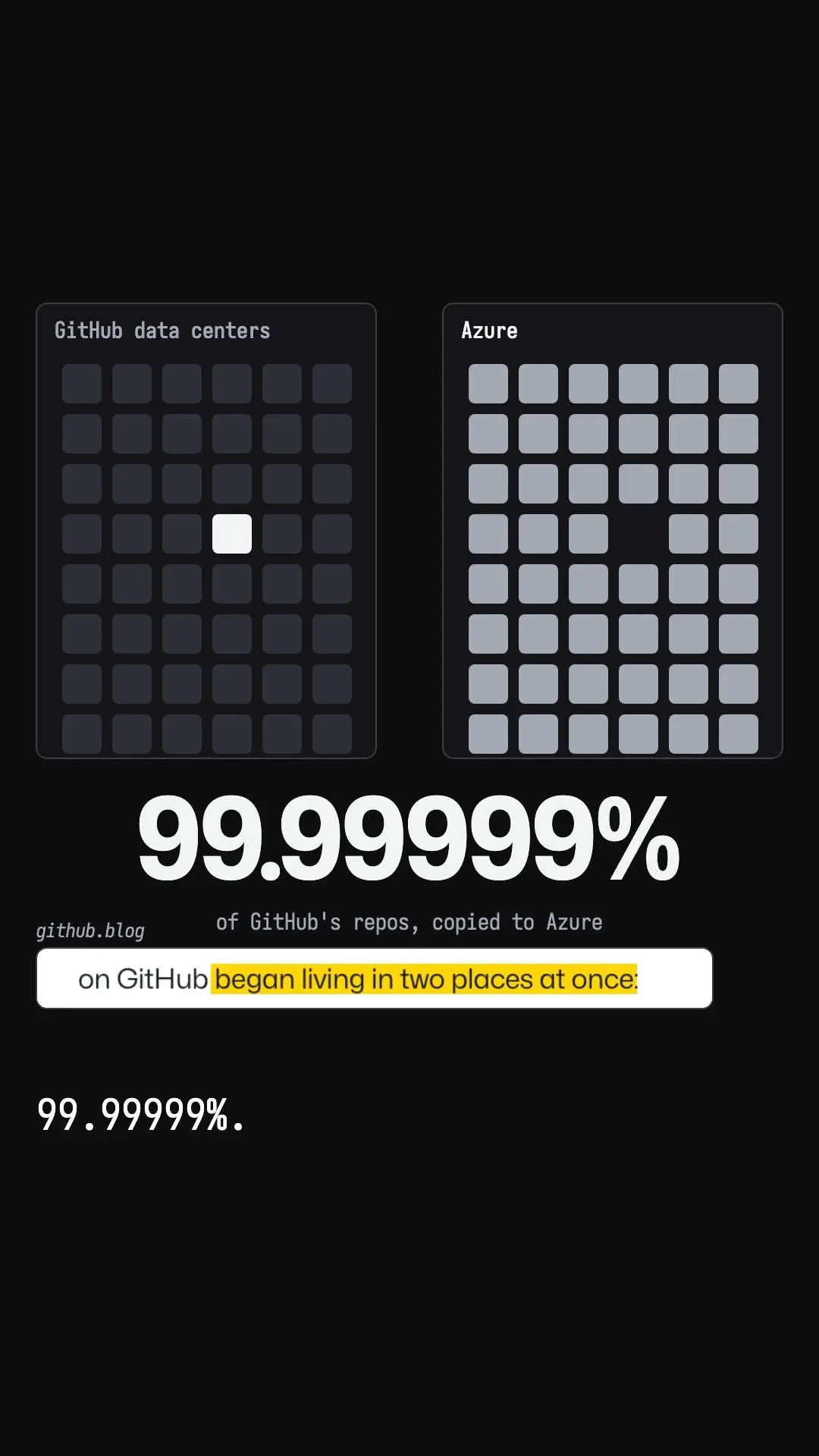
GitHub's own blog says the move was driven by "a hard ceiling on the power capacity of our data centers", and that "99.99999% of the Git repositories on GitHub began living in two places at once": its data centers and Azure. The rest are the busiest, "held back by just one thing: a 25ms round trip", because every write waits for every replica while a repository-wide lock is held. GitHub's fix: reads move to copies that spin up on demand (its load tester "hit its own limits first"), and the lock shrinks from the whole repository to each reference, so pushes to different branches stop waiting for each other: "3–4x higher throughput" in internal testing.
Source: "The bridge to agent-scale Git infrastructure", The GitHub Blog, Oct 21, 2026 (Eleanor White and Victoria Dye) https://github.blog/engineering/architecture-optimization/the-bridge-to-agent-scale-git-infrastructure/ Also: Vlad Fedorov, "The August 17 outage, and the work ahead", The GitHub Blog, Aug 20, 2026.
The data hall going dark, the lanes, the gate, the timers, the reader stadium and the load gauge are dramatizations; every quote and number on screen is from the sources.
How long did your last git push wait?
Transcript
AI agents push so much code, GitHub's data centers ran out of power for more servers. Sounds like a meme? It's on GitHub's own blog, a hard ceiling on power. But it's your problem, too. On a busy repo, your push waits in line, one write at a time. So it copied its repos to Azure, 99.99999%. But the last ones are the busiest, and they're stuck on 25 milliseconds. Because every write waits for every copy, and the whole repo stays locked until the slowest answers. Move them now, and each write waits longer than the one before. But pushes aren't even the crowd. For every write, up to a thousand reads on the same machines. So reads move out to copies that spin up on demand. GitHub's load tester gave out first. So GitHub shrinks the lock from the whole repo to one branch. Your push stops waiting for theirs. Three to four times the throughput, and GitHub's not done yet. Because…